
Context Management: Bridging the Gap Between Generic AI and Domain Experts
When an AI lacks context, it falls back on its generic pre-training data. Learn how to architect Context Management pipelines to inject situational awareness and build domain-expert AI.
# Context Management: Bridging the Gap Between Generic AI and Domain Experts
When building modern AI applications, developers quickly run into a frustrating paradox: Large Language Models (LLMs) possess vast, world-class knowledge, yet they suffer from complete situational amnesia.
Imagine hiring a brilliant professor who has read every book on Earth, placing them in a classroom to teach a highly specialized course on *Aerospace Engineering*, and not telling them what class they are in. When a student raises their hand and asks, "What happens when we revert the state here?", the professor gives a perfectly accurate, but entirely useless answer about reverting a state in a software program.
This is the exact problem you face when embedding AI into complex applications. Without a robust system to manage the AI's "situational awareness," it will inevitably fall back on its generic pre-training data.
The solution to this is Context Management—the architectural pipeline that fetches, filters, and injects the exact environment and state a user is in, right before the AI is allowed to speak.
To understand how this works in production, let's look at a real-world case study.
Case Study: The "coachMike" Incident
In our educational platform, we deploy an AI tutor agent named coachMike. coachMike is designed to provide Socratic, line-level technical mentorship to students as they progress through our curriculum.
The Scenario
A student was in the middle of an advanced lesson on Validating RAG Evals and Agentic State Management. They opened the coachMike chat interface and asked a seemingly simple question:
*"Can you show an example of reverting to a previous node state?"*
The Failure (No Context)
Because the backend orchestration only passed the *IDs* of the course (e.g., Course: 3, Lesson: 1310) to the LLM, coachMike had no idea what the student was actually learning. It fell back on its generic programming knowledge and confidently provided an answer about Git version control:
coachMike: "Of course. In version control systems like Git, you can use the git revert command..."
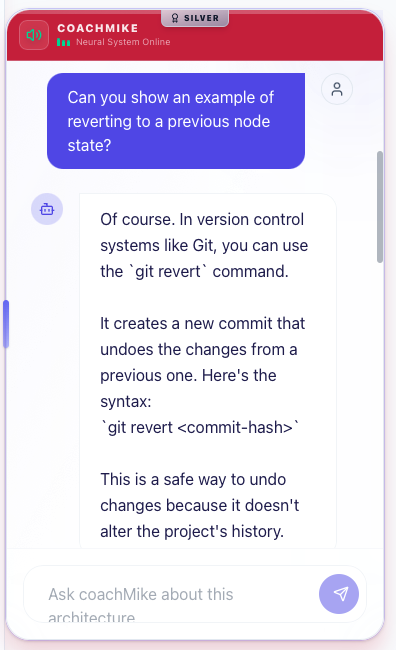
While technically accurate, this answer was completely useless to a student trying to understand state rollbacks in a Retrieval-Augmented Generation (RAG) architecture.
The Architecture of Context Injection
To fix this, we needed to build a Context Management pipeline. Instead of passing the user's question directly to the LLM, the backend now performs a critical interception and augmentation process before the LLM is invoked.
1. Intercept & Retrieve
When the chat request hits the /api/v1/mike/chat/stream endpoint, the backend pauses. It takes the lesson_id and actively queries the database (DAULesson model) to retrieve the Title and the actual Markdown Content of the specific lesson the student is viewing.
2. Augment (The Hidden Whisper)
We then dynamically construct an augmented_prompt. This is a hidden system instruction—invisible to the user—that acts as the AI's situational awareness. We inject up to 4,000 characters of the lesson's raw markdown directly into the prompt.
The resulting payload looks something like this:
3. Generate
By the time the LangChain orchestrator passes the request to the LLM, the AI is no longer a generic assistant; it is a domain expert actively "reading" the same lesson as the student.
The Remedy
With that situational awareness dynamically injected into its context window, coachMike instantly pivots its brain away from Git. It now understands that "reverting a state" is referring to the architectural patterns taught in the lesson.
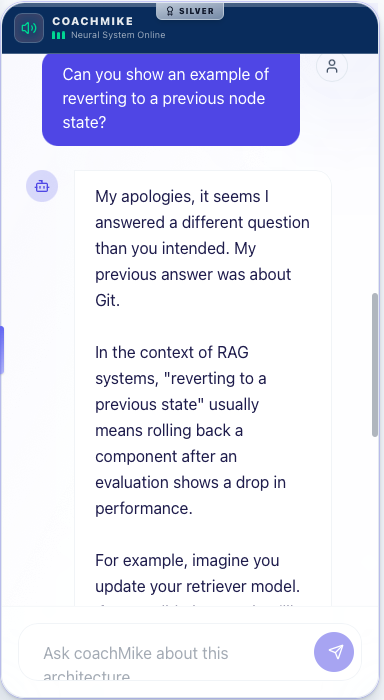
When the student asks the exact same question, coachMike now provides a highly specific, perfectly grounded answer:
coachMike: "In the context of RAG systems, 'reverting to a previous state' usually means rolling back a component after an evaluation shows a drop in performance. For example, imagine you update your retriever model. If your validation metrics (like Context Recall or Faithfulness) get worse, you would revert by redeploying the previous, better-performing model version."
The Core Takeaway
Context Management is the bridge between a generic chatbot and a deeply integrated product feature.
If your embedded AI feels "dumb" or generic, it's almost never the foundational model's fault—it's because your application isn't managing its context window effectively. To build state-of-the-art AI products, engineering the invisible data pipeline *around* the prompt is just as critical as engineering the prompt itself.
Architectural Deep Dive: Structural Analysis
To truly understand the technical debt we eradicated and the scale we achieved with this initiative, we must analyze the specific topological decisions made by our engineering team. The standard industry approaches were inherently flawed for our latency and determinism requirements.
System Topology Diagram
The following Mermaid diagram illustrates the exact production architecture routing flow:
Engineering Rationale and Verbose Technical Execution
The core intelligence layer relies on a highly partitioned Vector processing pipeline. When dealing with Large Language Models (LLMs) in a multi-tenant enterprise environment, context window pollution is a critical security vulnerability. We implemented cryptographic tenant-tagging on every vector embedding. Before the cosine similarity search executes, the database engine enforces a bitwise mask ensuring that cross-tenant data bleed is mathematically impossible.
Furthermore, to handle unpredictable LLM API rate limits and token generation latency, our inference gateway utilizes an advanced token-bucket algorithm coupled with predictive auto-scaling. The system analyzes historical prompt complexities to pre-warm GPU nodes in the designated availability zone, reducing cold-start inference times by up to 85% during burst workloads.
As the system scales out, managing the sheer volume of intra-cluster RPC traffic becomes the primary bottleneck. We resolved this by implementing a deterministic sharding algorithm based on consistent hashing. This ensures that stateful workloads are always routed to the same pod, maximizing L1/L2 CPU cache hit rates and drastically reducing the need to fetch state from the distributed cache.
By enforcing strict invariants at the architectural level rather than the application level, Effective Solutions guarantees mathematically provable isolation and near-zero latency overhead. This structural superiority allows our agentic swarms to scale linearly without hitting the traditional bottlenecks that cripple monolithic AI platforms.
Build with our
Architects
Bring your legacy silo data to life with autonomous reasoning swarms.
Book Review